MLA STYLE
In all courses specific to the Languages program, you will be required to write your papers in MLA style.
For more detailed information, refer to the MLA Handbook 8th edition and other resources provided by your teacher.
______________________________________________________________
The Basics
- Text is double-spaced, including quotations (no extra spaces after paragraphs).
- 12 pt. font size / Times New Roman font (or other approved fonts from your professor).
- No bold or underlined writing in your paper.
- 1-inch margins on all four sides.
- Right side of paper is NOT justified.
- No title page required, unless specified by your professor.
- The heading should be your name, followed by your professor’s name, the course name, and the date (using military format where the date appears before the month)
- Title is centered below your heading. Same font as the rest of your text, NOT bolded or italicized and capitalized (except for insignificant small words)
- Page numbers in the upper right-hand corner (except page 1). It must be ½ inch from the top and flush with the right margin. Includes last name, followed by a space with a page number.
- Book Titles, Journals, or Major Works should be italicized.
- “Articles”, “Short Stories”, “Poems”, should be put in quotations marks.
- Only one space after periods or other punctuation marks.
- New paragraphs indented ½ inch. Use your TAB key to indent properly.
______________________________________________________________
In-text Citations
- All framed direct and indirect borrowings (quotes and paraphrases) are followed by the page number in parentheses after the quotation marks and before ending punctuation:
Woodrow Wilson declared, “It is not learning but the spirit of services that will give a college a place in the public annals of the nation” (453).
“The faulty study resulted in crop mismanagement,” Dr. Broomfield comments (27).
- The author’s last name and the page number of the source separated by a single space are in parentheses to identify the source of each passage or idea used:
Antony’s “modifications of Brutus’s formulaic oratory are the first hint that [Anthony] knows his business” (Macrone 45).
- Quotations longer than four typed lines become block quotes, are indented twice, and are introduced with a colon.
- When two or more sources are cited within a single sentence, the parenthetical notes appear right after the statements they support.
- When you need to document a work without an author, simply list the title, shortened if necessary, and the page number, using quotes or italics as is appropriate.
- Avoid in-text citations of websites by identifying the site in your paper itself.
- Always introduce and explain how each quotation supports your argument!
______________________________________________________________
Works Cited
- “Works Cited” is centered at the top of the page
- The page number is present
- Include only sources mentioned in the paper; if you did not cite them in your paper, do not include them here! Always cross- reference your paper and your Works Cited page to make sure you have everything.
- Items on the Works Cited page are arranged in alphabetical order by last name of the author. If no author is given, list it according to the title.
- The first line of each entry is flush with the left-hand margin. Subsequent lines of the entry are indented five spaces/tabbed once.
- The list is entirely Double-spaced. Do not quadruple-space between entries or the title.
- There is a period at the end of each entry.
—
Websites that can help you write your papers in MLA Style
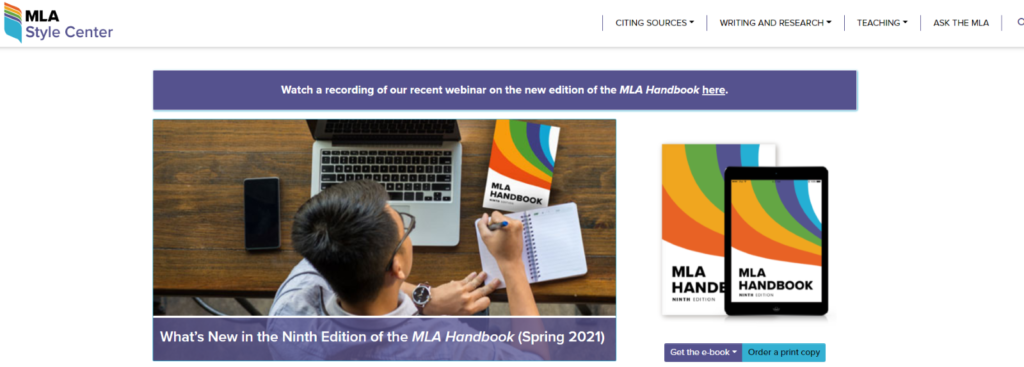
The MLA Style Center – Modern Language Association
MLA Style Center, the only authorized Web site on MLA style, provides free resources on research, writing, and documentation.
—
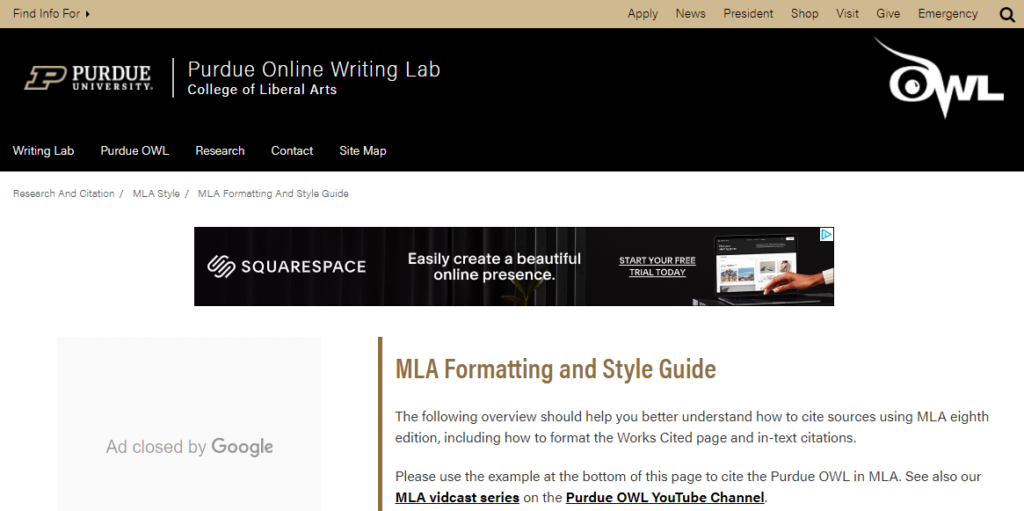
The Purdue University Online Writing Lab – MLA Formatting and Style Guide
The Purdue University Online Writing Lab serves writers from around the world.
—
Videos tutorials
How to Set Up MLA Format in Word.
—
What Are In-Text Citations?
—
How to make an MLA Works Cited page in Word.